Showing posts with label Rhynchostylis. Show all posts

Rhynchostylis coelestis and Hybrid

Deep purple color is quite rare in nature but can tissue culture.


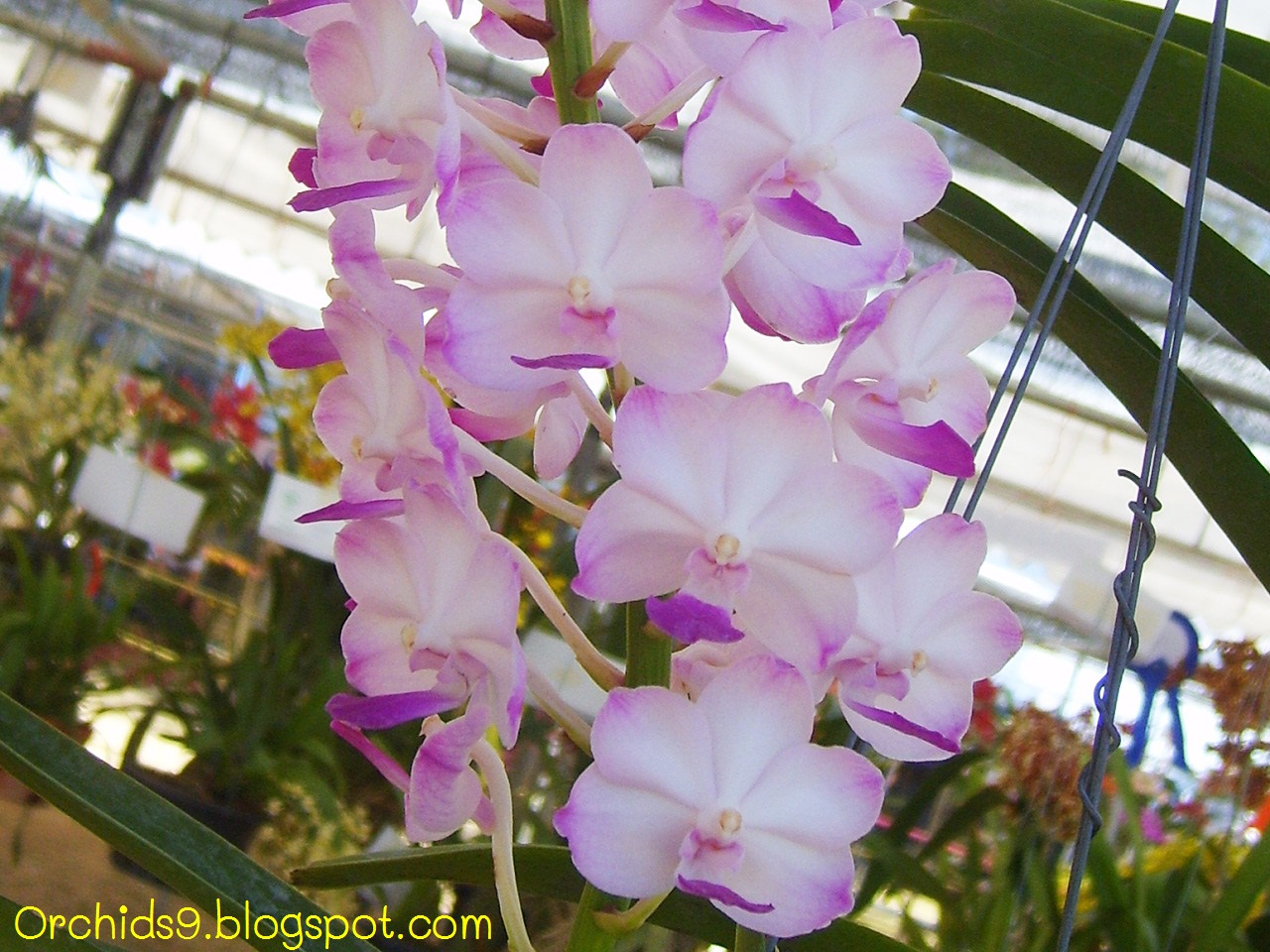
Pink color Rhyn. coelestis.


The orchid below is hybrid orchid, I guess that its was breed between Rhyn. coelestis and Rhyn. gigantea.


Rhynchostylis

Rhynchostylis gigantea orchid

Rhynchostylis gigantea orchid
Synonym : Anota densiflora gigantea, Vanda densiflora
Native range : Thailand, Myanmar, Malaysia, Laos, Vietnam, Philippines, China, Bangladesh, Borneo and Cambodia.
Skill for Culture : Experienced
Type of Culture : Warm grower
Described by : John Lindley
Described in : 1833
Type of Grow : Epiphytes ; Growing on clinging to branches of trees by large roots.
Growing Patterns : Monopodial; Orchids are growing always grows vertically.

Description
       Rhynchostylis gigantea grows in hot, low-altitude forests.


Rhynchostylis gigantea orchid
Flowers
       Many flowers carry by inflorescence, studded with purple or pink dots. flowers are very fragrant. This orchid flowers in winter.

Culture
       Cultivate in a hanging basket containing. The plant requires temperature which must never fall below 15 Celsius. Air humidity of more than 80 percent. Need bright light.--Not direct sun.


Vanda pairoj x Rhynchostylis coelestis | Orchid Flower Picture

Vanda pairoj x Rhynchostylis coelestis

Vanda pairoj x Rhynchostylis coelestis

Vanda pairoj x Rhynchostylis coelestis


Growing-Character
     Rhynchostylis is monopodial-type; Orchids are growing always grows vertically. Bud that on apex will sprout leaves alternately, growth continues while old leaves and stem will die. Roots and leaves sprout alternately from below to upward. Bud completely healthy will sprout new plant.

Growing-Environment
     Rhynchostylis orchids grow naturally in warm, moist, Shaded tropical areas. It's tolerant of a wider range of light conditions than other. Hobbyists wanting to grow them will need a warm, humid growing environment with air movement. Their unusually fragrant blooms often appear in the slightly cooler Winter months.

     Despite being in the Vanda Tribe, they are very different from Vandas. It is  They grow more slowly, their roots are more fragile, and almost any direct sun will harm them. However, they are typically grown with no potting mix on slat baskets or mounted just like Vandas.

Roots
     Aerial roots; Most orchids grow on trees. Large Root which acts to store water to feed itself. Resistant to drought very well. If be grown in potting. Roots attaches potting for stem stable. If the orchid is completely healthy ,Root will branching away.

Species of Rhynchostylis 
     Rhynchostylis is one of the Orchid family, consisting of 3 currently species 
  • Rhynchostylis gigantea (Lindl.) Ridl.
  • Rhynchostylis coelestis (Rchb.f.) A.H.Kent in H.J.Veitch 
  • Rhynchostylis retusa (L.)
     Rhynchostylis native to the Indian Subcontinent, China, Indochina, Malaysia, Indonesia and the Philippines.

     The Subtribe was changed from Sarcanthinae (Benth, 1881) to Aeridinae (Pfitzer, 1887) in 1972.

Sei. mitrata x Rhynchostylis coelestis. Orchids

Sei. mitrata x Rhync. coelestis
        Characteristics

Sepals : shaped like Rhyn. coelestis. Color like Sei. mitrata(But darker).
Petals  : shaped like Rhyn. coelestis (But bigger). Color like Sei. mitrata(But darker).


Sei. mitrata x Rhync. coelestis

Sei. mitrata x Rhync. coelestis

Lip     : shaped like Rhyn. coelestis. Color like Sei. mitrata.


Sei. mitrata x Rhync. coelestis

Inflorescences : Look like Rhyn. coelestis. Spherical inflorescences Pointed upward.

Sei. mitrata x Rhync. coelestis


Leaf   :    Look like Rhyn. coelestis.


I think... Only color comes from Sei. mitrata.

Pictures of Seidenfadenia mitrata. Click Here!
Pictures of Rhynchostylis coelestis. Click Here!

----------------------------------------------------------------------------------
Rhynchostylis coelestis (Rchb.f.)

Distribution
     Widespread in Cambodia Thailand, and Vietnam. at elevation 700 meters and lower. Found place semi-deciduous and deciduous forests that dry lowland.

     17-25 cm tall, Leaves have 3-5 cm wide, and 10-15 cm long.

     Epiphytes-type; Growing on clinging to branches of trees. Roots orchids have thick roots covered with silver or white velamen. Which adsorb moisture and nutrients from the air such as Plalaenopsis Cattleya Dendrobium etc.

     Flowers are fragrant. Size about 2 cm. Sepal and Petal are similar, White color and end of there have little blue color. Lip have blue color. Erect inflorescence and 17-23 cm long, cylindrical-shape. many flower in inflorescence.

Blooming in Summer and Fall.
----------------------------------------------------------------------------------
Seidenfadenia mitrata

In 1972. The genus was established by the American botanist Leslie Garay as a segregate of Aerides.
'mitratum' which differs from typical species of the genus because of its erect inflorescence.

In 1864. H.G. Reichenbach described this 'charming thing' in the Botanische Zeiting.

(Prof. Gunnar Seidenfaden)

Renanthera bangkok flame x Rnst. azimah

Rnst. azimah Orchid

Rnst. azimah is a hybrid between the genus Renanthera with Rhynchostylis gigantea.

Rnst. azimah Orchid

Rnst. azimah Orchid plant

Rnst. azimah growth long standing. The stem is strong.

Cultivation  : the light 40-50%.

Grow  :  plant it in a big pot, introduce a clay pot, put the charcoal.


----------------------------------------------------------------------------------
Rhynchostylis gigantea (Lindl.) Ridl
     Rhynchostylis gigantea was discovered in Burma (Myanmar) by Wallich.

In 1833. Lindley described as Saccolabium giganteum.

In 1896 Its was transferred to Rhynchostylis by Ridley.

Today, there was pollen-cross. Until its have varietal names applied to different color and forms.

Blooming
     Rhynchostylis gigantea blooms in January to February.

Distribution
     Rhynchostylis widespread in Hainan, Andaman Islands, Myanmar, Thailand, Vietnam, Laos, Cambodia, Malaysia, Borneo, Philippines

Rhynchostylis gigantea var.rattana [2] | Red Flowers

Rhynchostylis gigantea var. rattana

Rhynchostylis gigantea var. rattana

Rhynchostylis gigantea var. rattana

Rhynchostylis gigantea var. rattana

Rhynchostylis gigantea var. rattana

Rhynchostylis gigantea var. rattana

Rhynchostylis gigantea var. rattana
----------------------------------------------------------------------------------

Growing-Character
     Rhynchostylis is monopodial-type; Orchids are growing always grows vertically. Bud that on apex will sprout leaves alternately, growth continues while old leaves and stem will die. Roots and leaves sprout alternately from below to upward. Bud completely healthy will sprout new plant.

Growing-Environment
     Rhynchostylis orchids grow naturally in warm, moist, Shaded tropical areas. It's tolerant of a wider range of light conditions than other. Hobbyists wanting to grow them will need a warm, humid growing environment with air movement. Their unusually fragrant blooms often appear in the slightly cooler Winter months.

     Despite being in the Vanda Tribe, they are very different from Vandas. It is  They grow more slowly, their roots are more fragile, and almost any direct sun will harm them. However, they are typically grown with no potting mix on slat baskets or mounted just like Vandas.

Roots
     Aerial roots; Most orchids grow on trees. Large Root which acts to store water to feed itself. Resistant to drought very well. If be grown in potting. Roots attaches potting for stem stable. If the orchid is completely healthy ,Root will branching away.

Species of Rhynchostylis 
     Rhynchostylis is one of the Orchid family, consisting of 3 currently species 
  • Rhynchostylis gigantea (Lindl.) Ridl.
  • Rhynchostylis coelestis (Rchb.f.) A.H.Kent in H.J.Veitch 
  • Rhynchostylis retusa (L.)
     Rhynchostylis native to the Indian Subcontinent, China, Indochina, Malaysia, Indonesia and the Philippines.

     The Subtribe was changed from Sarcanthinae (Benth, 1881) to Aeridinae (Pfitzer, 1887) in 1972.

Rhynchostylis gigantea (Lindl.) Ridl
     Rhynchostylis gigantea was discovered in Burma (Myanmar) by Wallich.

In 1833. Lindley described as Saccolabium giganteum.

In 1896 Its was transferred to Rhynchostylis by Ridley.

Today, there was pollen-cross. Until its have varietal names applied to different color and forms.

Blooming
     Rhynchostylis gigantea blooms in January to February.

Distribution
     Rhynchostylis widespread in Hainan, Andaman Islands, Myanmar, Thailand, Vietnam, Laos, Cambodia, Malaysia, Borneo, Philippines
-----------------------------------------------------------------
        Rhynchostylis gigantea. The most popular is certainly not inevitable Rhynchostylis gigantea.It is a quadruped? Oh Yes! Elephants are the orchids that have been most interested in our home that has it. With a bouquet of flowers for a pretty long chain coupled with a strong smell. The colorful variety of enticements to lure the eye as well as desserts. It could be the first orchid species that lures many to enchant the eye until the distraction of people know it. The orchid is addictive and the withdrawal is made, it is not a science. gigantea is a genus of orchid Rhynchostylis gigantea is a lot that I remember that gigantea is large with a ring of cattle into a new meaning. Orchids are a very big snout like a bird.
 
     
It also has one of the Orchid Resort. The trunk.
Rhynchostylis gigantea, This is a very big different from other orchid genus, it has a thick layer of beautiful plump and stacked. Stems are very strong in the north, we find a kind of Rhynchostylis gigantea known as Rhynchostylis gigantea mighty dwarf, it leaves the nest together to form a V, which is when the lump Dwarf elephants virtually worthless for anything until the current dwarf, Rhynchostylis gigantea, elephants are much higher return. The botanical. I have given the scientific name for the elephant. Stunted as well. I called in Rhynchostylis gigantea var. Illustre

Rhynchostylis gigantea var. vivaphandhul. | Orange Flowers

Rhynchostylis gigantea var. vivaphandhul.
Rhynchostylis gigantea var. vivaphandhul.

Rhynchostylis gigantea
        The most popular is certainly Rhynchostylis gigantea, it's getting the most attention in my country. because a inflorescences are long, and a strong smell. Colorful like candy. Rhynchostylis gigantea are a very big lip like a bird.
 
----------------------------------------------------------------------------------
Growing-Character
     Rhynchostylis is monopodial-type; Orchids are growing always grows vertically. Bud that on apex will sprout leaves alternately, growth continues while old leaves and stem will die. Roots and leaves sprout alternately from below to upward. Bud completely healthy will sprout new plant.

Growing-Environment
     Rhynchostylis orchids grow naturally in warm, moist, Shaded tropical areas. It's tolerant of a wider range of light conditions than other. Hobbyists wanting to grow them will need a warm, humid growing environment with air movement. Their unusually fragrant blooms often appear in the slightly cooler Winter months.

     Despite being in the Vanda Tribe, they are very different from Vandas. It is  They grow more slowly, their roots are more fragile, and almost any direct sun will harm them. However, they are typically grown with no potting mix on slat baskets or mounted just like Vandas.

Roots
     Aerial roots; Most orchids grow on trees. Large Root which acts to store water to feed itself. Resistant to drought very well. If be grown in potting. Roots attaches potting for stem stable. If the orchid is completely healthy ,Root will branching away.

Species of Rhynchostylis 
     Rhynchostylis is one of the Orchid family, consisting of 3 currently species 
  • Rhynchostylis gigantea (Lindl.) Ridl.
  • Rhynchostylis coelestis (Rchb.f.) A.H.Kent in H.J.Veitch 
  • Rhynchostylis retusa (L.)
     Rhynchostylis native to the Indian Subcontinent, China, Indochina, Malaysia, Indonesia and the Philippines.

     The Subtribe was changed from Sarcanthinae (Benth, 1881) to Aeridinae (Pfitzer, 1887) in 1972.
----------------------------------------------------------------------------------
Rhynchostylis gigantea (Lindl.) Ridl
     Rhynchostylis gigantea was discovered in Burma (Myanmar) by Wallich.

In 1833. Lindley described as Saccolabium giganteum.

In 1896 Its was transferred to Rhynchostylis by Ridley.

Today, there was pollen-cross. Until its have varietal names applied to different color and forms.

Blooming
     Rhynchostylis gigantea blooms in January to February.

Distribution
     Rhynchostylis widespread in Hainan, Andaman Islands, Myanmar, Thailand, Vietnam, Laos, Cambodia, Malaysia, Borneo, Philippines

Ascocenda tubtim velvet x Rhynchostylis coelestis

Ascocenda tubtim velvet x Rhynchostylis coelestis

Ascocenda tubtim velvet Rhynchostylis coelestis

Ascocenda tubtim velvet Rhynchostylis coelestis

Ascocenda tubtim velvet Rhynchostylis coelestis

Growing-Character
     Orchid is monopodial-type; Orchids are growing always grows vertically. Bud that on apex will sprout leaves alternately, growth continues while old leaves and stem will die. Roots and leaves sprout alternately from below to upward. Bud completely healthy will sprout new plant.

Growing-Environment
     Orchids grow naturally in warm, moist, Shaded tropical areas. It's tolerant of a wider range of light conditions than other. Hobbyists wanting to grow them will need a warm, humid growing environment with air movement. Their unusually fragrant blooms often appear in the slightly cooler Winter months.

     Despite being in the Vanda Tribe, they are very different from Vandas. It is  They grow more slowly, their roots are more fragile, and almost any direct sun will harm them. However, they are typically grown with no potting mix on slat baskets or mounted just like Vandas.
----------------------------------------------------------------------------------
Rhynchostylis coelestis (Rchb.f.)

Distribution
     Widespread in Cambodia Thailand, and Vietnam. at elevation 700 meters and lower. Found place semi-deciduous and deciduous forests that dry lowland.

     17-25 cm tall, Leaves have 3-5 cm wide, and 10-15 cm long.

     Epiphytes-type; Growing on clinging to branches of trees. Roots orchids have thick roots covered with silver or white velamen. Which adsorb moisture and nutrients from the air such as Plalaenopsis Cattleya Dendrobium etc.

     Flowers are fragrant. Size about 2 cm. Sepal and Petal are similar, White color and end of there have little blue color. Lip have blue color. Erect inflorescence and 17-23 cm long, cylindrical-shape. many flower in inflorescence.

Blooming in Summer and Fall.
----------------------------------------------------------------------------------
Ascocenda tubtim ???

Asco. pirojsand x Rhyn. coelestis Orchid Hybrid

Asco. pirojsand x Rhyn. coelestis Orchids Pictures
Asco. pirojsand x Rhyn. coelestis Orchids Pictures

        This Ascocentrum, Ascocentrum Pirojsand x Rhynchostylis Coelestis. Hardly any difference from Ascocentrum Pirojsand.


Growing-Character
     Rhynchostylis is monopodial-type; Orchids are growing always grows vertically. Bud that on apex will sprout leaves alternately, growth continues while old leaves and stem will die. Roots and leaves sprout alternately from below to upward. Bud completely healthy will sprout new plant.

Growing-Environment
     Rhynchostylis orchids grow naturally in warm, moist, Shaded tropical areas. It's tolerant of a wider range of light conditions than other. Hobbyists wanting to grow them will need a warm, humid growing environment with air movement. Their unusually fragrant blooms often appear in the slightly cooler Winter months.

     Despite being in the Vanda Tribe, they are very different from Vandas. It is  They grow more slowly, their roots are more fragile, and almost any direct sun will harm them. However, they are typically grown with no potting mix on slat baskets or mounted just like Vandas.

Roots
     Aerial roots; Most orchids grow on trees. Large Root which acts to store water to feed itself. Resistant to drought very well. If be grown in potting. Roots attaches potting for stem stable. If the orchid is completely healthy ,Root will branching away.
---------------------------------------------------------------
Rhynchostylis coelestis (Rchb.f.)

Distribution
     Widespread in Cambodia Thailand, and Vietnam. at elevation 700 meters and lower. Found place semi-deciduous and deciduous forests that dry lowland.

     17-25 cm tall, Leaves have 3-5 cm wide, and 10-15 cm long.

     Epiphytes-type; Growing on clinging to branches of trees. Roots orchids have thick roots covered with silver or white velamen. Which adsorb moisture and nutrients from the air such as Plalaenopsis Cattleya Dendrobium etc.

     Flowers are fragrant. Size about 2 cm. Sepal and Petal are similar, White color and end of there have little blue color. Lip have blue color. Erect inflorescence and 17-23 cm long, cylindrical-shape. many flower in inflorescence.

Blooming in Summer and Fall.
-----------------------------------------------------------------

Ascocentrum x Rhynchostylis | Orchid Hybrid

Ascocentrum x  Rhynchostylis coelestis Orchid Flowers

Ascocentrum x  Rhynchostylis coelestis Orchid Flowers

Ascocentrum x  Rhynchostylis coelestis Orchid Flowers

Ascocentrum x  Rhynchostylis coelestis Orchid Flowers

        I'm not sure about name of them. I think it's name Ascocentrum Janis [Hybrid, Thailand.]