Showing posts with label Hybrid. Show all posts
Yellow Hybrid Orchids Flowers
Type of Culture : Warm grower
Type of Grow : Epiphytes; grows clinging to the branches of trees.
Growing Patterns : Monopodial; Orchids are growing always grows vertically.
Culture & Care
Air humidity of more than 70 percent and much of light.
Type of Grow : Epiphytes; grows clinging to the branches of trees.
Growing Patterns : Monopodial; Orchids are growing always grows vertically.
Culture & Care
Air humidity of more than 70 percent and much of light.
Piroj Sam (Pink) Orchids
Skill for Culture : -
Type of Culture : Warm grower
Type of Grow : Epiphytes; grows clinging to the branches of trees.
Growing Patterns : Monopodial; Orchids are growing always grows vertically.
Name of Orchid : Piroj Sam (ไพโรจน์ แซม)
Flower
Look like Seidenfadenia mitrata.
Leaves
Look like Vanda.
Mokara Hybrid | Orchids Flowers Pictures
Orchids > Mokara Orchids > Mokara Hybrid
| Mokara Orchid Pink Flower |
--------------------------------------------------------------------------------------
| Mokara Orchid Yellow Flower |
| Mokara Orchid Red Flower Pictiure |
| Mokara Orchid Red Flower Plant |
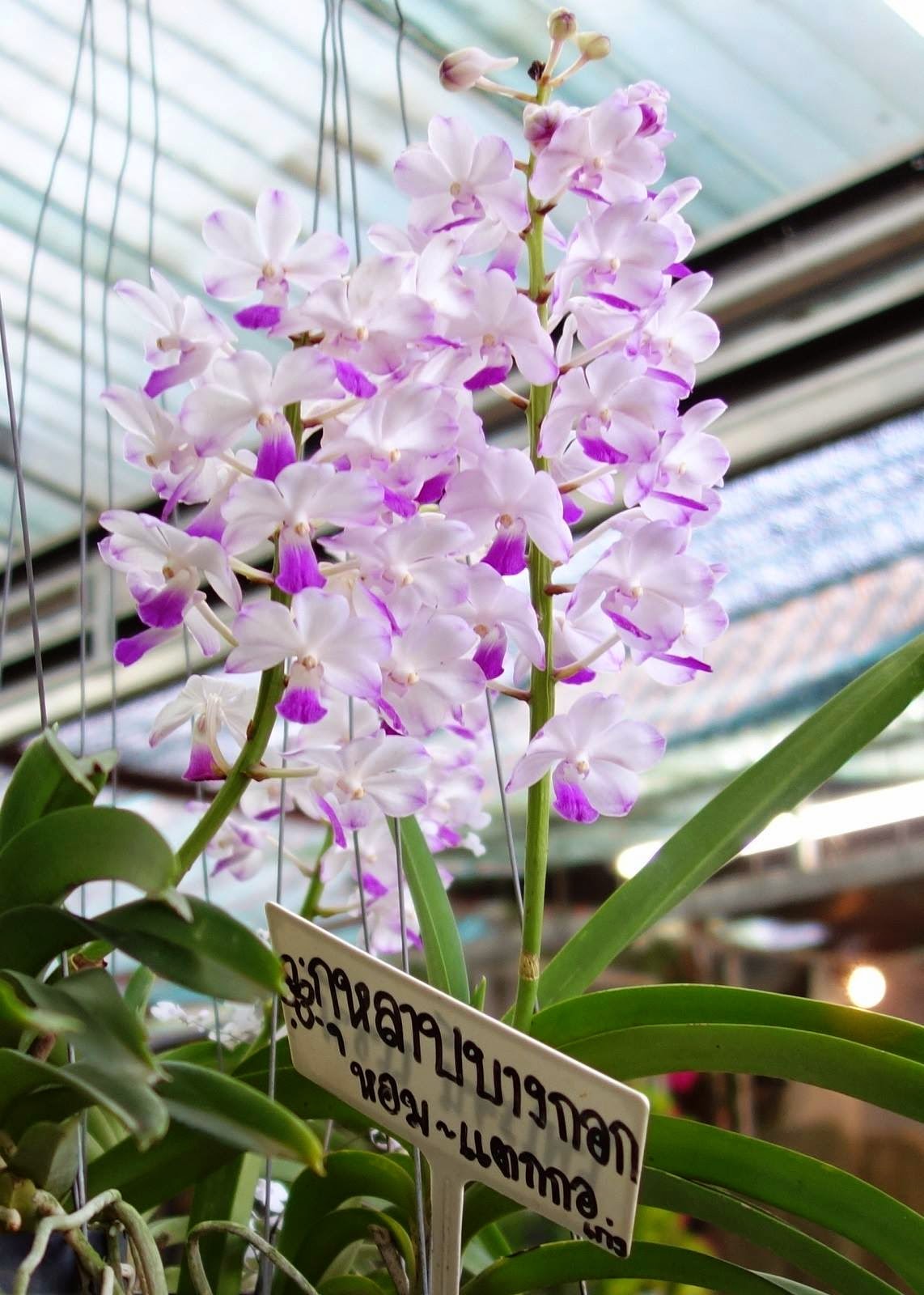
Vanda x Rhynchostylis coelestis Orchids
Orchids > Vanda Orchids > Vanda x Rhyn. coelestis
| Vanda Purple Flower |
| Vanda Purple Flower Plant |
----------------------------------------------------------------------
Vanda orchid is genus was popular and grow for a long time, as well as the Cattleya and Dendrobium. Due to an orchid with features such as Wood plant easily. Because the Vanda orchid like the weather is rather hot, high humidity and Bright light
----------------------------------------------------------------------------------
Rhynchostylis coelestis (Rchb.f.)
Distribution
Widespread in Cambodia Thailand, and Vietnam. at elevation 700 meters and lower. Found place semi-deciduous and deciduous forests that dry lowland.
17-25 cm tall, Leaves have 3-5 cm wide, and 10-15 cm long.
Epiphytes-type; Growing on clinging to branches of trees. Roots orchids have thick roots covered with silver or white velamen. Which adsorb moisture and nutrients from the air such as Plalaenopsis Cattleya Dendrobium etc.
Flowers are fragrant. Size about 2 cm. Sepal and Petal are similar, White color and end of there have little blue color. Lip have blue color. Erect inflorescence and 17-23 cm long, cylindrical-shape. many flower in inflorescence.
Blooming in Summer and Fall.
17-25 cm tall, Leaves have 3-5 cm wide, and 10-15 cm long.
Epiphytes-type; Growing on clinging to branches of trees. Roots orchids have thick roots covered with silver or white velamen. Which adsorb moisture and nutrients from the air such as Plalaenopsis Cattleya Dendrobium etc.
Flowers are fragrant. Size about 2 cm. Sepal and Petal are similar, White color and end of there have little blue color. Lip have blue color. Erect inflorescence and 17-23 cm long, cylindrical-shape. many flower in inflorescence.
Blooming in Summer and Fall.
Cattleya memory angel x (Cattleya bowringiana x Cattleya chocolate drop)
Orchids > Cattleya Orchids > Cattleya memory angel x (Cattleya bowringiana x Cattleya chocolate drop)
| Cattleya memory angel x (Cattleya bowringiana x Cattleya chocolate drop) |
| Cattleya memory angel x (Cattleya bowringiana x Cattleya chocolate drop) |
| Cattleya memory angel x (Cattleya bowringiana x Cattleya chocolate drop) |
Cattleya orchid was well known widely. Because the flowers are large and color. For cut-flowers trade.and then, People began to be interested in Cattleya orchid, It become more popular. Cattleya was developed rapidly, some species formerly flower size 5 cm. Can breed new flower size, 15 cm. And has colorful orchid more vivid.
Cattleya orchids hybrid , Sometimes ftagrant flowers. Some of the most stunning orchids in cultivation are cattleyas.
Type of Growing
Cattleya orchid is growing is Sympodial-type; Orchids are growing that grow sideways across the top of the pot. These orchids have a rhizome at the base usually put in horizontal, The bud at the base will begin growing anther rhizome. and then ,The rizome develops into a small plant or pseudobulb, and flower. When pseudobulbs have completely healthy, It will lose its leaves celled this pseudobulbs that "backbulb". It served store feed more years before it die.
Cattleya are epiphytes ; Growing on clinging to branches of trees. Roots orchids have thick roots covered with silver or white velamen. Which adsorb moisture and nutrients from the air such as Plalaenopsis Dendrobium etc.
Type of Roots
Cattleya orchids are semi-aerial roots : Usually found on the rocks or the trees. Roots can be absorbed many water. it smaller aerial roots. Most roots inside the pot. But may have some roots emerge outside the pot. This orchid roots not like a tight pots or wet for too long, Which getting air not enough.
Den. thyrsiflorum x Den. palpebrae Lindl.
Paphiopedilum philippinense x Paph exul | Orchids Flowers
Orchids > Paphiopedilum Orchids > Paphiopedilum philippinense x Paphiopedilum exul.
Paphiopedilum exul are shrub about 30-40 cm wide. Leaves 2.5-3 cm wide, 20-30 cm long. Its green leaves. Easy-sprout. Growth is usually big clumps. Single flower, size 6-7 cm. Peduncle 12-15 cm long, Petals on a white beach, greenish yellow color. The large purple spots and brown. Narrow yellow petals in it. Petals on a downward wave front. The petals are medium brown Greenish yellow.
Flowering in April-June Found on the limestone Adjacent coastal. 10 -100 meters from sea level.
The environment is similar to other slipper. But Paphiopedilum exul. in an area that has received quite a lot of light.
| Paphiopedilum philippinense x Paphiopedilum exul. |
| Paphiopedilum philippinense x Paphiopedilum exul. |
Flowering in April-June Found on the limestone Adjacent coastal. 10 -100 meters from sea level.
The environment is similar to other slipper. But Paphiopedilum exul. in an area that has received quite a lot of light.
| Paphiopedilum philippinense x Paphiopedilum exul. |
| Paphiopedilum philippinense x Paphiopedilum exul. |
| Paphiopedilum plant |
Cattleya siam dragon | Flowers Pictures
Orchids > Cattleya Orchids > C. siam dragon
Cattleya Flowers
Inflorescence
Flower stalk originates from a pseudbulb. The number of flowers are 2.
Orchid is the queen of the forest. It's beautiful. The plants were so beautiful to look at. Whenever orchids begin flowering, I will happy.
Bringing orchids to grow, it is not difficult. But it's hard to make it liven.
The orchid is a species that live in the forest. When taken comes out of the forest environment, climate changed. orchid that can't adapt new environment will die. some adaptability, It may be incomplete.
There are 1,000 of orchid species. Cattleya orchid is one of the most popular genus, because the flowers are large and colorful. Originated from a of southern !
In 1817, William Swainso found new varieties of plant in the country's Brazilian and sent discrimination (also sent to Sir.William Cattley).
In ..., Sir. William Cattleya grow this plants(orchid ) in his farms, until its flowering.
In 1824, John Lindley named this type of orchid, called "Cattleya John Lindley."
About Cattleya
Cattleya orchid was well known widely. Because the flowers are large and color. For cut-flowers trade.and then, People began to be interested in Cattleya orchid, It become more popular. Cattleya was developed rapidly, some species formerly flower size 5 cm. Can breed new flower size, 15 cm. And has colorful orchid more vivid.
Cattleya orchids hybrid , Sometimes ftagrant flowers. Some of the most stunning orchids in cultivation are cattleyas.
Type of Growing
Cattleya orchid is growing is Sympodial-type; Orchids are growing that grow sideways across the top of the pot. These orchids have a rhizome at the base usually put in horizontal, The bud at the base will begin growing anther rhizome. and then ,The rizome develops into a small plant or pseudobulb, and flower. When pseudobulbs have completely healthy, It will lose its leaves celled this pseudobulbs that "backbulb". It served store feed more years before it die.
Cattleya are epiphytes ; Growing on clinging to branches of trees. Roots orchids have thick roots covered with silver or white velamen. Which adsorb moisture and nutrients from the air such as Plalaenopsis Dendrobium etc.
Type of Roots
Cattleya orchids are semi-aerial roots : Usually found on the rocks or the trees. Roots can be absorbed many water. it smaller aerial roots. Most roots inside the pot. But may have some roots emerge outside the pot. This orchid roots not like a tight pots or wet for too long, Which getting air not enough.
Culture
Generally, Put it in *
Leaves.
Generally, Leaves of Cattleya orchid will emerge from the pseudobulb, 1-2 ea depend on species. Usually the leaves will be apple green. If it's darker leaves might indicate too little light, and if yellow/brown leaves might indicate too much direct sunlight.
Temperature and Light.
Temperature 14 to 23 'C. (It can adapt.)
Light ; Cattleya orchids like bright light. but not to direct sunlight. They will not flower without plenty of light. If the leaves are dark green and floppy, the orchids is not getting enough light.
| Cattleya siam dragon Picture |
- Flower size about 5-15 cm.
- Dorsal Sepal : Rather narrow(than petals) Like the triangle, pink color
- Lateral Petal : Darkker than color sapal.
- Lateral Sepal : Similar to each other, triangle, pink color
- Lip : various marking and often frilly margin.
Inflorescence
Flower stalk originates from a pseudbulb. The number of flowers are 2.
| Cattleya siam dragon Plant |
Orchid is the queen of the forest. It's beautiful. The plants were so beautiful to look at. Whenever orchids begin flowering, I will happy.
Bringing orchids to grow, it is not difficult. But it's hard to make it liven.
The orchid is a species that live in the forest. When taken comes out of the forest environment, climate changed. orchid that can't adapt new environment will die. some adaptability, It may be incomplete.
There are 1,000 of orchid species. Cattleya orchid is one of the most popular genus, because the flowers are large and colorful. Originated from a of southern !
In 1817, William Swainso found new varieties of plant in the country's Brazilian and sent discrimination (also sent to Sir.William Cattley).
In ..., Sir. William Cattleya grow this plants(orchid ) in his farms, until its flowering.
In 1824, John Lindley named this type of orchid, called "Cattleya John Lindley."
About Cattleya
Cattleya orchid was well known widely. Because the flowers are large and color. For cut-flowers trade.and then, People began to be interested in Cattleya orchid, It become more popular. Cattleya was developed rapidly, some species formerly flower size 5 cm. Can breed new flower size, 15 cm. And has colorful orchid more vivid.
Cattleya orchids hybrid , Sometimes ftagrant flowers. Some of the most stunning orchids in cultivation are cattleyas.
Type of Growing
Cattleya orchid is growing is Sympodial-type; Orchids are growing that grow sideways across the top of the pot. These orchids have a rhizome at the base usually put in horizontal, The bud at the base will begin growing anther rhizome. and then ,The rizome develops into a small plant or pseudobulb, and flower. When pseudobulbs have completely healthy, It will lose its leaves celled this pseudobulbs that "backbulb". It served store feed more years before it die.
Cattleya are epiphytes ; Growing on clinging to branches of trees. Roots orchids have thick roots covered with silver or white velamen. Which adsorb moisture and nutrients from the air such as Plalaenopsis Dendrobium etc.
Type of Roots
Cattleya orchids are semi-aerial roots : Usually found on the rocks or the trees. Roots can be absorbed many water. it smaller aerial roots. Most roots inside the pot. But may have some roots emerge outside the pot. This orchid roots not like a tight pots or wet for too long, Which getting air not enough.
Culture
Generally, Put it in *
Leaves.
Generally, Leaves of Cattleya orchid will emerge from the pseudobulb, 1-2 ea depend on species. Usually the leaves will be apple green. If it's darker leaves might indicate too little light, and if yellow/brown leaves might indicate too much direct sunlight.
Temperature and Light.
Temperature 14 to 23 'C. (It can adapt.)
Light ; Cattleya orchids like bright light. but not to direct sunlight. They will not flower without plenty of light. If the leaves are dark green and floppy, the orchids is not getting enough light.
Bulbophyllum lasiochilum (Black) x Bulb. paruwel
This orchids hybrid between Bulbophyllum lasiochilum (Black) and Bulbophyllum paruwel.
| Bulbophyllum lasiochilum (Black) and Bulbophyllum paruwel. |
Epiphytes ; Growing on clinging to branches of trees. Roots orchids have thick roots covered with silver or white velamen.
| Bulbophyllum lasiochilum (Black) and Bulbophyllum paruwel. |
Bulbophyllum Orchid is Sympodial; Orchids are growing that grow sideways across the top of the pot. These orchids have a rhizome at the base usually put in horizontal, The bud at the base will begin growing anther rhizome. and then ,The rizome develops into a small plant or pseudobulb, and flower. When pseudobulbs have completely healthy, It will lose its leaves celled this pseudobulbs that "backbulb". It served store feed more years before it die.
| Bulbophyllum lasiochilum (Black) and Bulbophyllum paruwel. |
Semi-aerial roots : Usually found on the rocks or the trees. Roots can be absorbed many water. it smaller aerial roots. Most roots inside the pot. But may have some roots emerge outside the pot. This orchid roots not like a tight pots or wet for too long time, Which getting air not enough. This roots orchids such as Cattleya, Cymbidium, Dendrobium and Oncidium.
| Bulbophyllum lasiochilum (Black) and Bulbophyllum paruwel. |
Pseudobuld is a cylindrical and light green color. look like Bulb. paruwel because Pseudobuld of bulb. lasiochilum is spherical.
Culture
Put it in warm temperatures, about 17-26'C. and use saran screen 50-60 percent. Keep moist in summer seasons [don't allow it dry]. Pot orchids in fine bark mounted or sphagnum moss.
| Bulbophyllum lasiochilum (Black) and Bulbophyllum Paruwel. |
- Flower size about 2.5-3.0 cm.
- Dorsal Sepal : look like bulb. lasiochilum . But it light red background with dark red strip color.
- Lateral Petal : look like bulb. lasiochilum . But it light red background with dark red strip color. and Slightly hairy.
- Lateral Sepal : Longer than bulb. lasiochilum and not roll. Color lighter with lighter red strip. While bulb. lasiochilum . roll and have dark red dot.
- Lip : Dark red color and waxy.
Leaves.
Generally, Leaves of lasiochilum orchid will emerge from the pseudobulb, only 1 ea. Green color.
Temperature and Light.
- Temperature 17 to 26 'C.
- Light should be about 50 to 60 percent.
Distribution
Man-made species Orchids.
| Bulbophyllum lasiochilum (Black) |
Den. cruentum x (Den.cruentum x Den. formosum) | Orchids Hybrid
Orchids > Dendrobium Orchids > Den. cruentum x donmali
Dendrobium cruentum x donmali
Den. donmali is Den.cruentum x Den. formosum
Den. cruentum x (Den. cruentum x Den. formosum)
Dendrobium orchids are epiphytes; Growing on clinging to branches of trees. Roots orchids have thick roots covered with silver or white velamen. Which adsorb moisture and nutrients from the air such as Plalaenopsis
The Orchid Growth
Sympodial; Orchids are growing that grow sideways across the top of the pot. These orchids have a rhizome at the base usually put in horizontal, The bud at the base will begin growing anther rhizome. and then ,The rizome develops into a small plant or pseudobulb, and flower. When pseudobulbs have completely healthy, It will lose its leaves celled this pseudobulbs that "backbulb". It served store feed more years before it die.
Orchids sympodial-type such as Paphiopedilum Dendrobium Cattleya Oncidium Bulbophyllum Grammatophyllum etc.
Dendrobium species are either epiphytic or lithophytic. They have adapted to a wide variety of habitats.
Dendrobium is sympodial-type of orchids. They develop pseudobulbs, which in length from less than 1 centimetre to several metres long, looklike canes. Leaf bases form sheaths that completely envelope the stem.
Ovate-leaves grow alternately over the whole length of the stems, Some species the leaves are bunched towards the apex of the stem. The axillary inflorescence in length from less to 1m long, and canes carry from a few to more 100 flowers. Deciduous species carry their leaves for one to two years then typically flower on leafless canes, while canes of evergreen species usually flower in the second year and can continue to flower for a number of years.
These orchids grow quickly throughout summer, but take a rest during winter. Dormant buds erupt into shoots from the base of the pseudobulb mainly in spring, and a few species in autumn. This is then followed by rapid growth of new roots. Reproduction is usually through seed.
| Den. cruentum x (Den. cruentum x Den. formosum) Orchid |
| Den. cruentum x (Den. cruentum x Den. formosum) Orchid |
Dendrobium cruentum x donmali
Den. donmali is Den.cruentum x Den. formosum
Den. cruentum x (Den. cruentum x Den. formosum)
Dendrobium orchids are epiphytes; Growing on clinging to branches of trees. Roots orchids have thick roots covered with silver or white velamen. Which adsorb moisture and nutrients from the air such as Plalaenopsis
The Orchid Growth
Sympodial; Orchids are growing that grow sideways across the top of the pot. These orchids have a rhizome at the base usually put in horizontal, The bud at the base will begin growing anther rhizome. and then ,The rizome develops into a small plant or pseudobulb, and flower. When pseudobulbs have completely healthy, It will lose its leaves celled this pseudobulbs that "backbulb". It served store feed more years before it die.
Orchids sympodial-type such as Paphiopedilum Dendrobium Cattleya Oncidium Bulbophyllum Grammatophyllum etc.
- In 1799, Olof Swartz establish Dendrobium genus.
- In 1981, Briegar reclassified all terete-leaved Dendrobiums from Australia and New Guinea into a new genus, Dockrillia. The Winika orchid from New Zealand was formerly D. cunninghamii, but has now been moved into a monotypic genus Winika
- In 1989, Clements upgraded the D. speciosum complex into individual species;[2] similarly, the D. bigibbum complex (which contains the well-known Cooktown Orchid of Australia, D. phalaenopsis) has recently been split up. However, as an illustration of the current revisions in the taxonomy of Orchidaceae these 'splits' have now been reversed and the currently accepted species, natural nothospecies and synonyms are presented on Wikispecies Dendrobium.
Dendrobium species are either epiphytic or lithophytic. They have adapted to a wide variety of habitats.
Dendrobium is sympodial-type of orchids. They develop pseudobulbs, which in length from less than 1 centimetre to several metres long, looklike canes. Leaf bases form sheaths that completely envelope the stem.
Ovate-leaves grow alternately over the whole length of the stems, Some species the leaves are bunched towards the apex of the stem. The axillary inflorescence in length from less to 1m long, and canes carry from a few to more 100 flowers. Deciduous species carry their leaves for one to two years then typically flower on leafless canes, while canes of evergreen species usually flower in the second year and can continue to flower for a number of years.
These orchids grow quickly throughout summer, but take a rest during winter. Dormant buds erupt into shoots from the base of the pseudobulb mainly in spring, and a few species in autumn. This is then followed by rapid growth of new roots. Reproduction is usually through seed.
Vanda denisoniana x Ascocenda khunnok
Paphiopedilum x ang-thong x Paphiopedilum concolor
Orchids > Paphiopedilum Orchids > Paph.
Paphiopedilum hybrid between Paphiopedilum "x ang-thong" and Paphiopedilum concolor
| *This is The sample picture. |
Paphiopedilum concolor (Lindl.) Pfitzer Click!
Paphiopedilum x ang-thong Click!
Paphiopedilum concolor Pfitzer x Paph. godefroyae.
Orchids > Paphiopedilum Orchids > Paph. concolor x godefroyae
| It's a hybrid between Paphiopedilum concolor Pfitzer and Paph. godefroyae. |
It's a hybrid between Paphiopedilum concolor Pfitzer and Paph. godefroyae.
| *This is The sample picture. Paph. concolor on the left.Paph. godefroyae. on the rigth. |
*Link to Paphiopedilum concolor (Lindl.) Pfitzer Click!
Paphiopedilum godefroyae var. ang-thong. or Paph. x ang-thong
Orchids > Paphiopedilum Orchids > Paph.
Paphiopedilum. The orchid found in Southeast Asia.
East Asia and South Asia.
Around the world meet Paphiopedilum and 5 genera (Genus) include 137 type (species).
The genus is found only in a single genus Paphiopedilum include 17 species from around the world were all about 70 type.
Lady's slipper can be found in India, Bangladesh, in the southeast of China, Bhutan, Nepal, Myanmar, Laos, Vietnam, Cambodia. Malaysia, Indonesia, Papua New Guinea and Solomon Islands, the Philippine botany divided subfamilies. "The lady's slipper." 5 genus. Is Cypripedium Paphiopedilum Phragmipedium,,, and, Selenipedium Mexipedium
*spam info. sorry.
| Paphiopedilum godefroyae var. ang-thong. or Paph. x ang-thong |
Paphiopedilum. The orchid found in Southeast Asia.
East Asia and South Asia.
Around the world meet Paphiopedilum and 5 genera (Genus) include 137 type (species).
The genus is found only in a single genus Paphiopedilum include 17 species from around the world were all about 70 type.
Lady's slipper can be found in India, Bangladesh, in the southeast of China, Bhutan, Nepal, Myanmar, Laos, Vietnam, Cambodia. Malaysia, Indonesia, Papua New Guinea and Solomon Islands, the Philippine botany divided subfamilies. "The lady's slipper." 5 genus. Is Cypripedium Paphiopedilum Phragmipedium,,, and, Selenipedium Mexipedium
*spam info. sorry.
Spathoglottis | Orchid Hybrid Pictures
| Pink Spathoglottis |
The orchid genus has more than 40 type (species).
| Soft Pink Spathoglottis |
It has spread from northern India, Sri Lanka, southern China, Malaysia, Philippines, Thailand, Indonesia and Papua New Guinea Australia. And the Pacific Islands.
| Yellow Spathoglottis |
| Plant Spathoglottis |
Subscribe to:
Posts (Atom)
Labels
Aerides
(4)
Anacheilium
(1)
Anota
(1)
Ascocentrum
(4)
Bulbophyllum
(25)
Cattleya
(16)
Christensonia
(1)
Cymbidium
(5)
Dendrobium
(16)
Dwarf Orchids
(1)
Encyclia
(2)
Epidendrum
(1)
Eria
(1)
Eulophia
(1)
Fruits
(1)
Grammatophyllum
(1)
Green Orchids
(1)
Growing Orchids
(4)
Hybrid
(36)
Mokara
(2)
Oncidium
(1)
Orange Orchid
(1)
Paphiopedilum
(9)
Papilionanthe
(1)
Phalaenopsis
(7)
Pink Orchid
(4)
Pleione
(2)
Pleurothallis
(1)
Polystachya
(1)
Prosthechea
(1)
Psychopsis
(1)
Psygmorchis
(1)
Purple Orchids
(2)
red orchid
(1)
Renanthera
(2)
Rhynchostylis
(15)
Rossioglossum
(1)
Sarcochilus
(1)
Seidenfadenia
(1)
Sobralia
(1)
Spathoglottis
(1)
Staurochilus
(1)
Trichoglottis
(1)
Unknow
(1)
Vanda
(21)
Vegetables
(1)
White Flower
(1)
Wild Orchids
(1)
Yellow Orchids
(1)
Zygopetalum
(1)